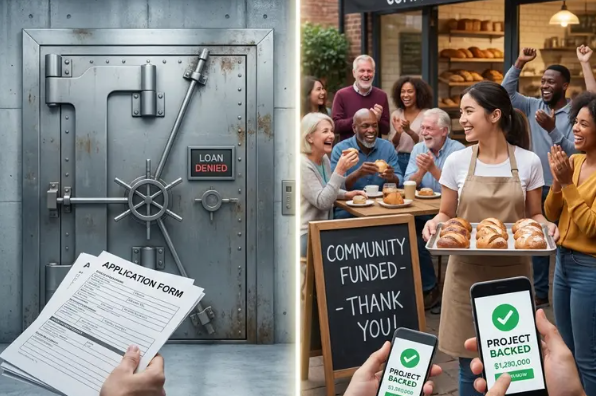
The realization hit us when we watched the funding gap widen right here in South Africa. Traditional banks demanded impossible collateral—property deeds, fixed assets, guarantees most township entrepreneurs simply don’t have. VCs focused exclusively on hyper-scalable tech startups in Sandton and Cape Town. Local entrepreneurs and community-driven initiatives in places like Soweto, Khayelitsha, and Durban got stranded in between.
This wasn’t a temporary blip.
The global shift toward the sharing economy and digital trust started outperforming institutional gatekeeping. People were more willing to back a transparent, mission-driven idea directly than a bank was to take a calculated risk on a dreamer.
The numbers tell the brutal truth both globally and locally: bank lending to small businesses declined significantly. In South Africa, SMEs contribute 34% of GDP yet struggle to access even 15% of total bank lending. The gap between what small businesses need and what banks are willing to provide has never been wider.
The Intangible Asset Problem
We watched this play out with businesses like Charly’s Bakery in Cape Town during the pandemic. To a South African bank, they were unconventional and risky—a retail food business facing total lockdown with no predictable cash flow, operating in an economy already under strain.
A traditional bank looks for collateral and historical stability. A VC looks for 10x scalability. A beloved local bakery that supports dozens of families doesn’t fit the VC “hockey stick” graph. It lacks the “safe” balance sheet a bank requires during a global crisis.
What made them unconventional in the eyes of institutions?
Intangible Assets: Their greatest value was community love and brand loyalty, which a bank cannot seize if a loan defaults.
Mission over Multiples: Their goal was survival and staff retention, not an aggressive exit strategy that VCs demand.
Hyper-Local Impact: Traditional institutions struggle to quantify the value of a business that is a cultural landmark rather than just a revenue generator.
Watching that disconnect—where a business with thousands of loyal fans is told they are “un-bankable”—is exactly why we at Jumpstarter leaned into the reward-based model.
How Crowdfunding Quantifies What Banks Can’t See
We’ve observed that reward-based crowdfunding acts as a real-time valuation engine for trust.
Where a bank sees a risky lack of physical collateral, crowdfunding transforms community love into a liquid, measurable asset through three specific mechanisms.
Market Validation as Collateral
Banks look at past performance to predict the future. That’s why they fail at funding innovation.
Crowdfunding looks at present demand.
When a creator offers a reward—like a name on the wall or a limited-edition product—and hundreds of people buy it upfront, they provide a non-dilutive cash advance. This monetizes loyalty by proving that a market exists before a single cent is spent on production.
The data backs this up: reward-based crowdfunding consistently delivers 39.6% success rates—dramatically outperforming the average 23% across all crowdfunding types.
Converting Brand Equity into Measurable Value
In the case of Charly’s Bakery, the intangible asset was decades of joy provided to the community. We watched that equity quantify itself into an average transaction value.
By offering rewards at different price points, we weren’t just asking for donations. We were allowing the community to price the value of the institution’s survival.
High-tier rewards—like private workshops—quantified the value of the bakery’s expertise. Low-tier rewards—like a “pay it forward” cupcake—quantified the value of their social presence.
De-risking via the Crowd-Vetting Effect
Traditional institutions spend thousands on due diligence to mitigate risk. In the reward-based model, the crowd performs that due diligence for free.
If 500 people are willing to put their own money down, the intangible risk of the project failing due to lack of interest is eliminated.
The funding itself becomes the proof of concept.
The Structural Breakdown of Traditional Funding
The approval rate crisis tells a stark story globally, but it’s even more acute in South Africa. While only 14.6% of small business loans were approved by big banks in the US, South African entrepreneurs face similar or worse odds, particularly those without property collateral or established credit histories.
This isn’t a temporary blip. It’s a structural failure.
Perhaps most revealing: entrepreneurs across the board—but especially in South Africa—don’t even apply for loans because they know they’ll be denied. That’s a damning indictment of how disconnected traditional institutions have become from the entrepreneurs they’re supposed to serve, particularly in emerging markets where innovation thrives despite capital scarcity.
The VC Gatekeeping Problem
The venture capital world has its own blind spots.
All-female founding teams received less than 1% of venture capital in Europe in 2024. In the U.S., only 2.3% went to all-female teams and 10.4% to mixed-gender teams. In South Africa, the picture is similarly bleak—women entrepreneurs face not only gender bias but also systemic barriers related to asset ownership and credit history.
Black investors make up just 4% of venture capitalists in the U.S. In South Africa, despite BEE policies and transformation rhetoric, the venture capital ecosystem remains concentrated among a small, predominantly white and male network. This creates an echo chamber where “homophily”—the tendency to fund people like yourself—becomes structural exclusion.
The data is brutal: underrepresented founders received only 43% of the funding that white male founders received (R1.65 billion vs. R3.8 billion on average in South African terms) despite research showing that diverse founding teams achieve 30% higher returns than homogenous teams.
Who Gets Access Now
The democratization data tells a different story.
In investment crowdfunding, 34% of new companies in 2024 had at least one woman founder and 34% had at least one minority founder—dramatically outperforming traditional VC where women-only teams get 1.9% of capital.
Crowdfunding proved more resilient than VC during downturns. 2024 levels reached 69% of their 2021 peak compared to VC at just 50%.
Crowdfunding platforms enable entrepreneurs to raise capital without the stringent requirements of banks or venture capitalists. Successful campaigns demonstrate demand that provides market validation—a form of crowd-vetting that eliminates the intangible risk banks claim to fear.
The Loyalty and Long-Term Stakeholder Advantage
We’ve seen how reward-backed supporters become long-term stakeholders in ways traditional investors never do.
Crowdfunding campaigns with videos earn 105% more than those without. 30% of the funding goal reached in the first week predicts ultimate success. This demonstrates that transparent storytelling and community engagement create capital momentum that traditional pitch decks to VCs cannot replicate.
Crowdfunding fosters community around a brand before launch. Businesses build loyal customer bases who become advocates—creating long-term stakeholder relationships rather than the transactional, exit-focused mentality of traditional investors.
Research shows that engaging with backers through updates and feedback strengthens relationships and leads to higher customer retention.
The Global Shift in Capital Flow
The numbers reveal a fundamental transformation.
The global crowdfunding market grew from $17.72 billion (approximately R321 billion) in 2024 to a projected $20.46 billion (R371 billion) in 2025, reflecting a 15.5% CAGR. Forecasts reach $38.71 billion (R702 billion) by 2029.
Community-driven funding models are experiencing exponential growth while traditional lending contracts.
The reward-based crowdfunding market reached $1.03 billion (R18.7 billion) in 2024 and is projected to hit $1.22 billion (R22.1 billion) by 2025, showing 1.84% growth even as traditional bank lending contracted.
As of January 2025, Kickstarter alone facilitated over 651,000 projects with more than $8.53 billion (R154.7 billion) pledged. Here at Jumpstarter, we’ve demonstrated that community-driven validation works in South African markets—that Mzansi entrepreneurs can mobilize their communities when traditional gatekeepers say no.
What This Means for the Future
Consumers are increasingly gravitating towards crowdfunding as a means of supporting innovative projects and social causes. This reflects a shift towards community-driven funding models, particularly among younger demographics who prioritize sustainability and social impact.
This is a generational transformation in how capital allocation decisions are made.
Crowdfunding has democratized access to capital, enabling entrepreneurs to develop products and services that align with broader population needs. It’s particularly effective at bridging the funding gap for innovative ventures that struggle to secure traditional financing.
Traditional small business loan underwriting involves 25-30 steps and can take 30-90 days to deliver. That timeline treats speed and agility as liabilities rather than assets, favoring those with existing wealth over those with existing community support.
The question isn’t whether community capital will replace traditional funding models.
The question is how quickly traditional institutions will adapt to recognize intangible assets as legitimate forms of collateral—or whether they’ll become irrelevant in the process.
Small businesses owned by people of color received approval for only 32% of their funding requests compared to 56% for white-owned businesses in 2023 in the US. In South Africa, the historical wealth gap means that Black entrepreneurs often lack the collateral banks demand—yet they possess exactly what crowdfunding values: deep community trust, cultural relevance, and loyal customer bases. Traditional underwriting fails to recognize these as legitimate forms of collateral.
The shift is already happening. Capital is flowing toward models that recognize intangible value. The institutions that survive will be the ones that learn to see what their spreadsheets have been missing all along.
Community love isn’t intangible anymore. It’s just measured differently.